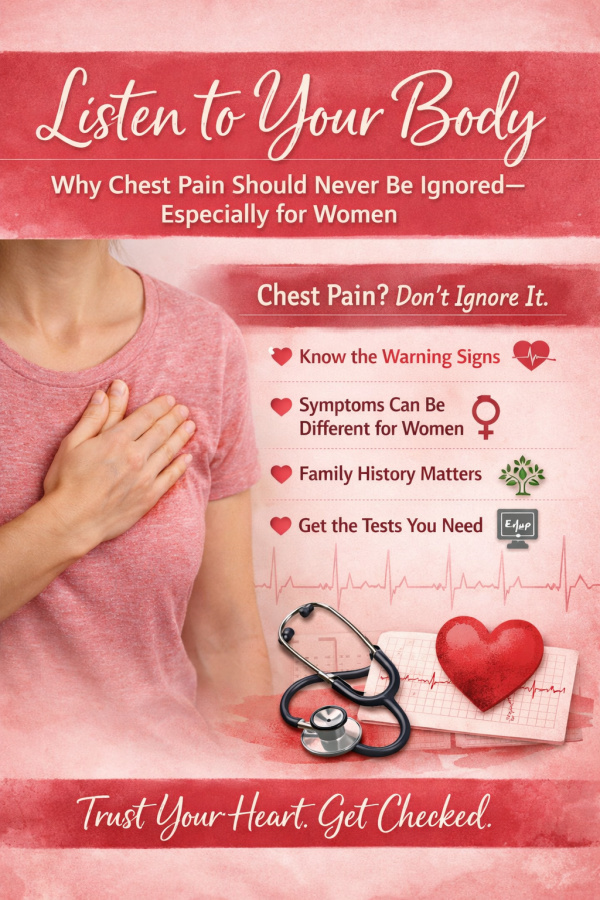
Let’s talk about something we’re really good at not doing…that is, listening to our bodies. Especially as women. We’re busy. We power through. We explain things away. We tell ourselves we’re just tired, stressed, anxious, dehydrated, or “probably fine”. And when it comes to chest pain? We are often the first ones to minimize it. But here’s the truth…your body whispers before it screams. And chest pain is not something to ignore. Ever.
*This post may contain affiliate links
Chest Pain Isn’t Always “Textbook”
When people think of a heart attack, they picture sudden, crushing chest pain and a dramatic collapse. That image has been drilled into us for decades. But that classic presentation is based largely on male symptoms. Heart attack symptoms in women can look very different…and this is where things get dangerous.
For women, warning signs can include:
- Chest pressure, tightness, or discomfort (not always a sharp pain)
- Pain in the jaw, neck, shoulder, or upper back
- Nausea or vomiting
- Unexplained fatigue
- Dizziness or lightheadedness
- A feeling of anxiety or “something isn’t right”
Do you notice something I do? How many of those warning signs are things we can easily brush off? That’s why so many women delay seeking care…or worst yet, they are initially dismissed when they do.
“It’s Probably Nothing” Is Not a Medical Plan
Here’s something I believe deeply, especially as women, you do not need to prove your pain is serious enough to get it checked out. Chest pain is your body asking for attention. Period. Even if it turns out to be reflux, muscle strain, anxiety, or inflammation, getting answers matters. Peace of mind matters. And catching something early can literally save your life.
Too many women are told:
- “You’re too young”
- “You’re labs look fine”
- “It’s probably stress”
- “Let’s wait and see”
HydroJug Traveler – 32 oz Water Bottle with Handle & Flip Straw – Fits in Cup Holder, Leak Resistant Tumbler-Reusable Insulated Stainless Steel & Rubber Base – Gifts for Women & Men, Pink Sand Zylo Premium 24oz Executive Cup – Insulated Stainless Steel Water Bottle Tumbler – Eco-Friendly Magnetic Glide Cap Travel Cup for Gym, Hiking, Office & Outdoor –12hr Hot/24hr Cold – Sagebrush GreenNalgene Sustain Tritan BPA-Free Water Bottle Made with Material Derived from 50% Plastic Waste (using ISCC certified mass balance), 16 OZ, Wide Mouth,Grey


Waiting, when you have chest pain, is not always the safest option when your heart is involved.
Family History Changes the Conversation
If you have a family history of heart disease, heart attacks, stroke, or cardiovascular issues, that information matters more than you may realize. Family history isn’t just a footnote or a box you check once a year on your physical paperwork. Family history is a risk factor.
When heart disease runs in your family:
- You may develop symptoms earlier
- You may need additional or earlier testing
- “Normal” results may still need deep evaluation
This is where being proactive, not reactive, comes in. Advocating for yourself might mean asking for cardiac imaging, stress testing, blood work beyond the basics, or follow-up testing instead of a one-time snapshot. Knowledge is power, and date gives you options.
Listening to Your Body is a Skill – And you’re allowed to Use It
We are taught to push through discomfort. To not be dramatic. To be strong. But strength also looks like:
“This doesn’t feel normal for me”
You know your body better than anyone else. If you’ve never experienced chest pain, then you need to get it checked when you do. If something feels off, persistent, unusual, or escalating…LISTEN!
Don’t downplay chest pain.
Don’t apologize for asking questions.
Don’t ignore symptoms because you’re afraid of being inconvenient.
Your heart works for you every single second of every single day. The least you can do is listen when it asks for attention.
And Remember…
If this post makes you pause, even for a moment, take that as a sign.
Pay attention.
Get checked.
Use your family history as information, not fear.
And remember, being proactive with your health is not overreacting…it’s wisdom.
Your body is always communicating. The question is, are we listening?
Leave a Reply